
The systems the business actually runs on.
Enterprise operations run on systems that cannot be switched off — ERP, logistics, document workflow, internal tooling. iLeaf modernises them in reversible phases with live users undisrupted, then adds automation where it pays for itself. Over 200 of the systems we have built are still in production.
Ask Lia about enterpriseWhat this includes
- Workflow systems
- Approval chains, document routing and case management shaped around how the work is genuinely done.
- ERP & integration
- Connecting the systems that were never designed to talk, without a rip-and-replace programme.
- Logistics & supply
- Tracking, delay prediction and proactive rerouting across operations that run continuously.
- Document intelligence
- Extraction and classification over the document volume that otherwise consumes back-office hours.
- Internal tooling
- The unglamorous admin systems your teams live in all day, built to be fast rather than impressive.
- IoT & connected operations
- Device data into operational decisions — the engineering behind Roost's connected-home platform.
How we run it
Every phase ships something usable on its own, so you are never holding a half-finished system waiting on the next milestone.
Map the real process
Including the spreadsheet and the group chat that the official process quietly depends on.
Modernise behind a seam
A stable interface lets pieces be replaced without callers noticing, so there is no single cutover weekend.
Automate the volume, escalate the rest
The repetitive majority is automated; exceptions route to people with the context already gathered.
Measure operational cost
Success is handling time, error rate and cost per case — not how modern the stack looks afterwards.
What we build it with
- TypeScript
- Node.js
- Python
- Java
- .NET
- PostgreSQL
- Kafka
- Temporal
- Docker
- Terraform
- AWS
- Azure
Questions we get asked
Can you modernise a system we cannot take offline?
That is the normal case. A stable interface goes in front of the existing system, then functionality moves behind it route by route, with the old path kept available until the new one has proven itself. Every phase is reversible, so there is never a weekend where the business is betting on a single cutover.
Where does automation pay off fastest in operations?
High-volume, rule-heavy work with a measurable cost of delay — document handling, approval routing, status chasing. We size the volume and the delay cost first, and if conventional engineering solves it more cheaply than AI, we say so. We once saved a client ₹12 lakh doing exactly that.
Do you work with our internal IT team?
Usually alongside them. They hold the institutional knowledge about why systems are the way they are, which is the most valuable input to a modernization plan. We adapt to your change process rather than importing our own.
Let’s talk about enterprise.
Tell us what you are running and what it needs to do next. We will tell you honestly whether we are the right team for it.
What we build for Enterprise
Modernise the systems you cannot switch off
Modernise ERP, workflow and operational systems in reversible phases, with live users undisrupted — then add AI where it pays.
Read moreAI agents for enterprise operations
Agents for document handling, approval routing and status chasing — automating the volume and escalating the rest.
Read moreDedicated teams for enterprise delivery
Embedded pods inside your process and repository, with UK, US and EU hours covered from three delivery locations.
Read more
Enterprise: the work behind this

Logistics
Procurement Automation for a Global Logistics Operator
A long-term engineering partnership with one of the world's largest shipping and logistics companies, modernising core procurement and material movement. Manual data entry was replaced with AI-integrated workflows for invoice matching and vendor communication.
Read the case study
Cloud
Streamlining Document Management with iLeaf Solutions: A Case Study in Optimizing Workflow Efficiency
The main aim of the project is to create a modern and customizable centralized Document Management System module that serves the requirements of the owner of different departments of any organization to manage all kinds…
Read the case study
Construction
A Unified EHS Workforce Compliance and Training Platform
Construction, energy, transportation and manufacturing operators were tracking workforce competency, certifications and equipment compliance across disconnected tools, spreadsheets and paper. We built the platform that put it in one place — now deployed across North America and Africa to thousands of users.
Read the case study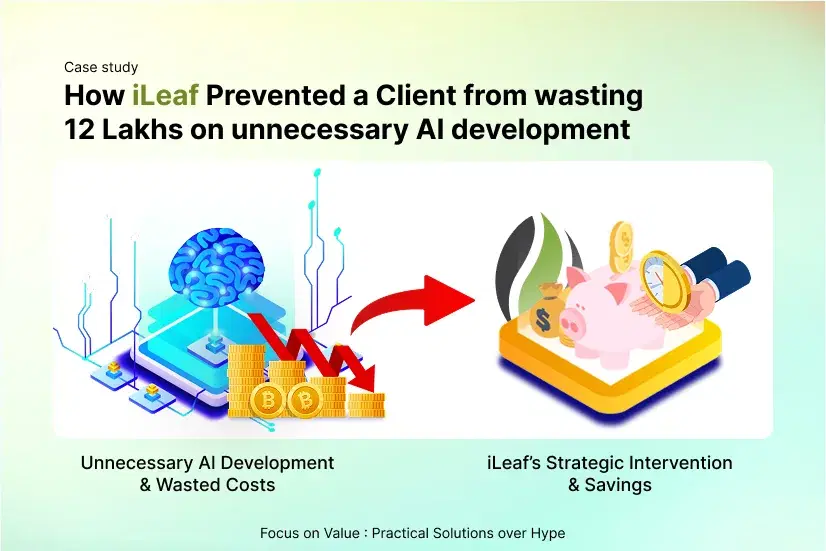
AI
“How iLeaf Prevented a Client From Wasting ₹12 Lakhs on Unnecessary AI Development”
A logistics company approached iLeaf wanting to build a GenAI-powered support…
Read the case study