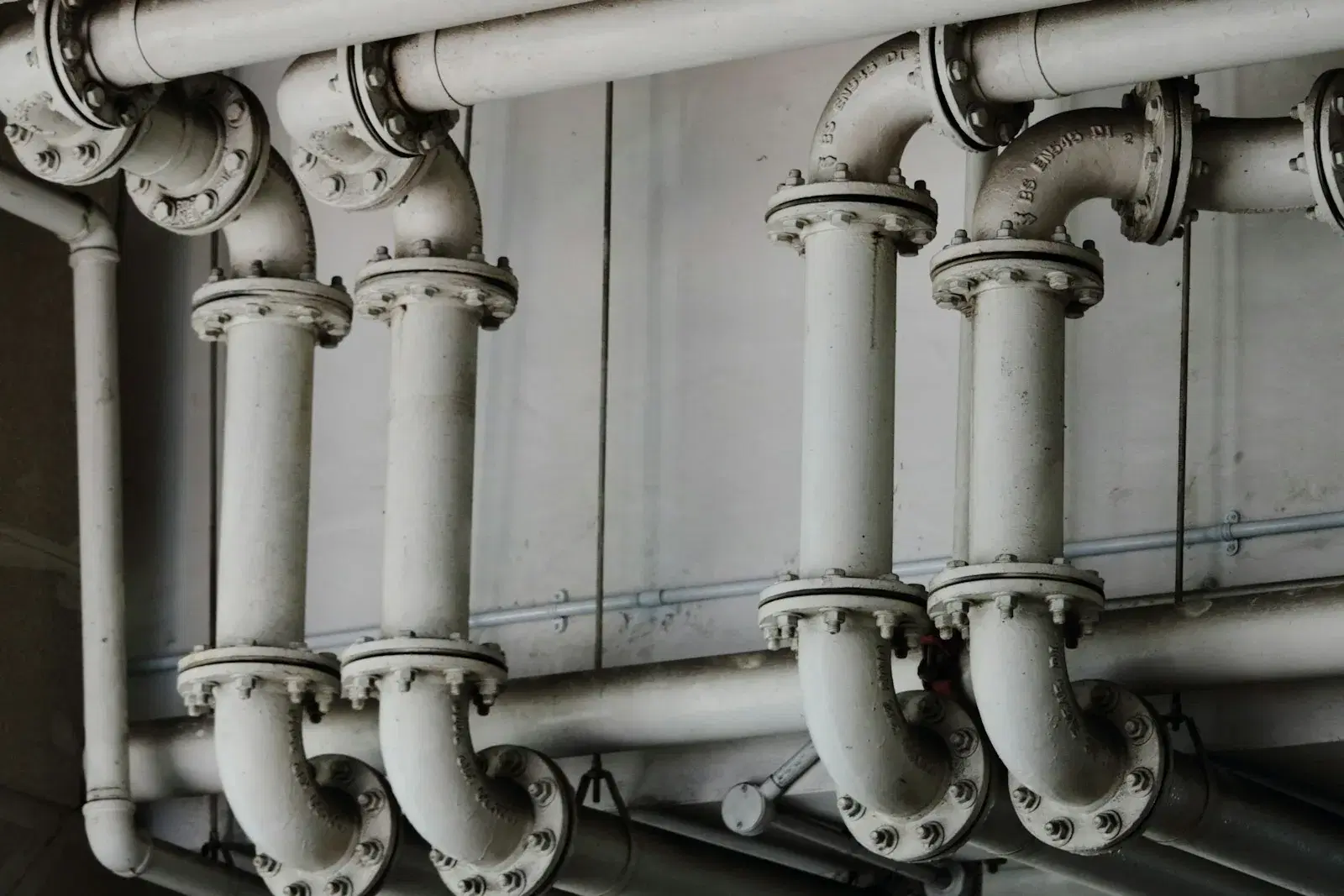
A water authority's estate is not a building. It is thousands of individual structures spread across a region, most of them below ground, several of them underwater, and almost none of them anywhere near a mobile signal.
Somebody has to go and look at each one on a cycle. What they record is the entire basis on which the authority decides where to spend its maintenance budget — and for a long time, at most operators, what they recorded was a paper form that was typed into a spreadsheet the following week by somebody who had not been there.
AIMS™ — Asset Inventory Management System — was built for CALM IPSUM Group LTD in the UK to manage water authority assets, and the whole design follows from one decision: the inspection is finished when the inspector walks away from the asset, not when the office finishes processing it.
The Challenge
The asset classes AIMS covers are worth naming, because each one sets a different constraint:
- Pipe bridges carry a main across a river, road or railway. They are above ground and visible, which makes them the easy case — but they are also frequently in the middle of a field, at the far end of an access track.
- CSO chambers — combined sewer overflows — are the structures that discharge to a watercourse when the system is over capacity. Their condition is a regulatory and environmental matter, not merely an operational one, so the record has to stand up to scrutiny long after the visit.
- Penstocks are the gates that control flow. They are mechanical, they seize, and inspecting one means assessing whether a moving part still moves.
- Detention tanks hold storm water. They are large and enclosed, which means the inspection is governed by a confined-space safety procedure before it is governed by an asset procedure.
Common to all four: they are visited rarely, by different people each time, in conditions where nothing works reliably.
The specific difficulties:
No connectivity, as the normal case. A chamber below a road, a tank below ground, a pipe bridge in a valley. These are not intermittent-signal environments; they are no-signal environments, and no amount of infrastructure investment changes that.
The record was assembled after the fact. Between the asset and the database sat a paper form, a van, a desk and a transcription. Every one of those steps loses detail, and the timestamp on the final record described the typing rather than the inspection.
Inspection quality depended on who turned up. An experienced inspector captures what matters. A new one captures what the form asks for. With a free-text form those are very different data sets, and neither is comparable to the other across a decade of records.
The people who needed the data were not the people collecting it. A field crew, a site manager and an executive looking at capital planning want three different views of the same inspection, and none of them wants the other two.
What We Built
A cross-platform survey application in React Native, backed by a secure cloud platform, in which the device holds the authoritative copy of an inspection until the network is available to take it.
Structured survey modules, with conditional logic
The inspection is not a form. It is a decision tree: the asset class determines which questions exist, and an answer determines what is asked next. A penstock that will not open leads somewhere different from one that opens stiffly.
Conditional logic is what makes an inspection comparable across inspectors and across years. It removes the judgement call about what to record — which is where inconsistency enters — while leaving the judgement call about what is true, which is the part the inspector is there for. It also means site safety data cannot be skipped, because the module will not advance without it.
Offline as the default state, not a fallback
Data is queued locally and submitted when a connection becomes available. Nothing about the inspector's workflow changes based on connectivity — there is no degraded mode, no warning banner, no retry to babysit, because the inspector can do nothing about the signal and should not be asked to think about it.
This is what the Redux-ORM and Redux-Saga layer is for. The store is a local relational model of the asset estate rather than a cache of API responses, and the saga layer owns the queue: what has been captured, what has been sent, what is still outstanding, and how to resume a submission that was interrupted halfway. That distinction — local database rather than response cache — is the difference between an application that works underground and one that merely survives a brief outage.
Dynamic categorisation of the estate
Assets are tagged and categorised dynamically rather than against a taxonomy fixed at build time. An authority's asset hierarchy changes: structures are reclassified, new categories are introduced by a regulatory change, and inherited records need to be filed against a scheme nobody anticipated.
Role-based visibility
The same inspection surfaces differently for a field crew, a site manager and an executive stakeholder. One needs the next job and the last visit. One needs exceptions across a patch. One needs condition profile across the estate for capital planning. Building three views over one record is considerably cheaper than the three separate systems most operators end up with.
Encrypted at rest, including the history
All data is stored securely and encrypted, and that explicitly includes survey history rather than only the current state. For an asset class whose condition is a regulatory matter, the value of the record is that it shows a trend — and a history that can be quietly altered is not evidence of anything.
Sewer Viewer
The same client, the same reasoning, a different estate. Sewer Viewer is the drainage authority inspection and management application — built in Flutter, with the same offline queueing and end-to-end encryption, and the same premise that capture happens at the asset.
Its emphasis is early detection. A blockage or a structural defect found while it is still small is a maintenance task; the same defect found after it fails is an excavation, a road closure and possibly a discharge. So the inspection captures photographs and geolocation alongside the condition assessment, on the basis that the next person to look at this asset will be a different person and the image is what makes the previous judgement reviewable.
That is the argument for the whole programme: extending asset life through early detection and targeted maintenance, rather than through a heavier inspection cycle.
The Approach
The device is the system of record. Everything else follows from this. A design where the server is authoritative and the device is a client cannot work in a confined space below a road, and retrofitting that inversion later means rewriting the write path.
Constrain the input to make the output comparable. Free text is easy to build and produces a decade of records that cannot be analysed. Structured, conditional capture is more work up front and is the only version that supports a trend.
Design for the confined space and the wet field. Gloves, bright sun, one hand, no signal, and a safety procedure that takes precedence over the software. This is the same constraint set behind our energy and field work, and it is why field applications built to an office specification get abandoned.
Never present a transcription as an observation. The record carries when it was captured, not when it was uploaded. For assets under environmental regulation, that distinction is the difference between a record and an assertion.
The Result
AIMS and Sewer Viewer are both in service with CALM IPSUM Group LTD in the UK, covering water authority and drainage asset inspection respectively.
CALM — Complete Asset Life Management — was acquired by Ipsum Group in February 2017 as Ipsum's first company investment, the transaction that opened their infrastructure and utilities growth strategy. Our engagement spans that period, and both products are recorded in our capabilities materials under the post-acquisition entity.
The pattern this project established runs through the rest of our field work: the AR sewer inspection application built for the same client puts the inventory on the road surface where the crew is standing, and ARMO adds live monitoring to the same class of buried network. The reasoning behind all three is set out in field data capture where there is no signal.
If you run a distributed physical estate and the inspection record is assembled after the visit rather than during it, tell us what you have.
Have a system that needs to do this?
500+ systems shipped since 2011, and we still maintain most of them. Tell us what you are trying to move.