
AI
The AI-Native Retrofit Strategy: How to Bring Agentic Automation to Legacy Software Without a Total Rebuild
By Vivek S N · 15 April 2026 · 5 min read
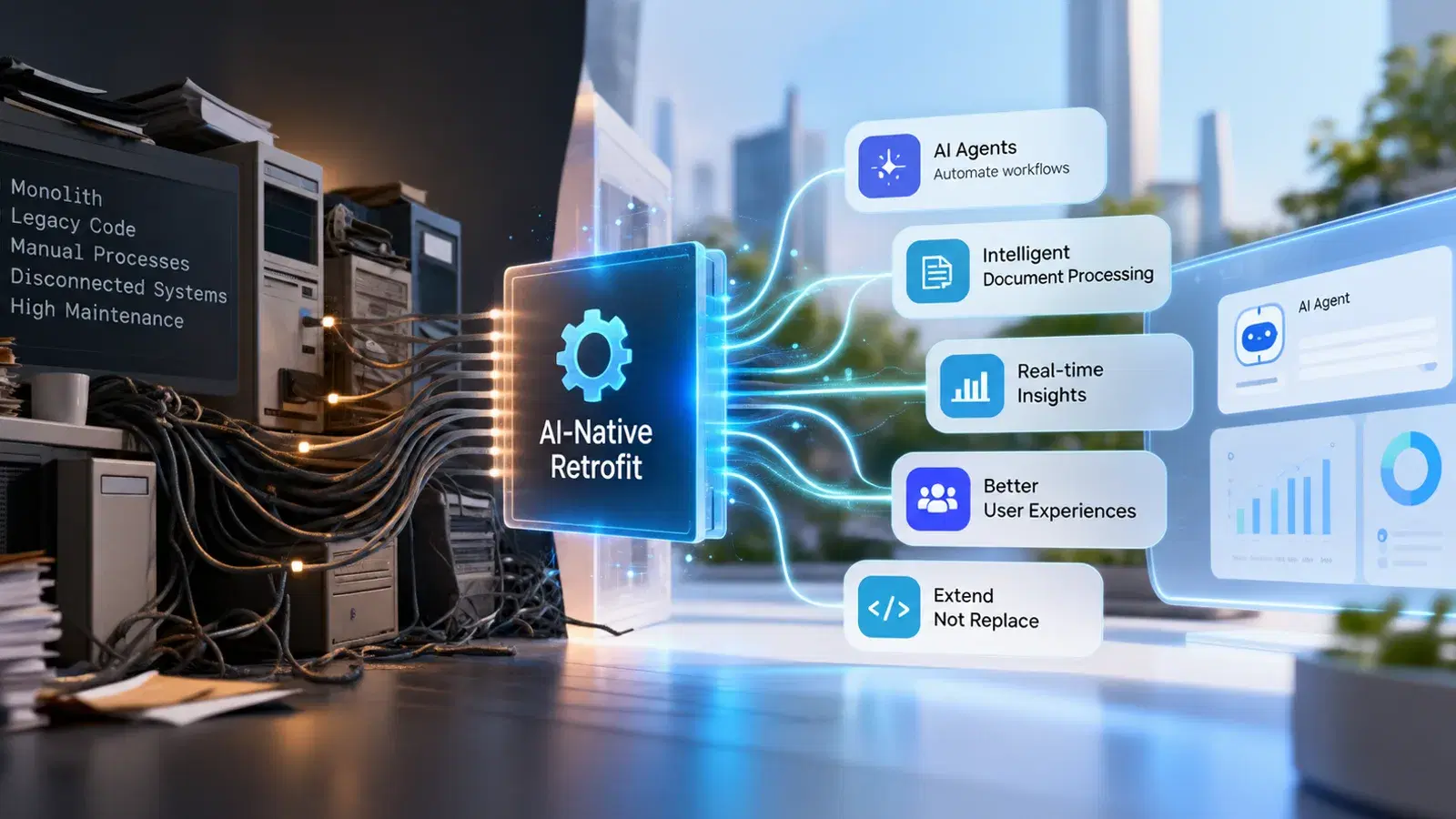
You need to bring agentic AI capabilities to your business, but your core operations run on legacy software. The idea of a total rebuild is daunting: years of development, a budget nobody wants to defend, and the risk of breaking the functions the company actually runs on. You have read the claims about AI transformation. The practical reality of replacing a system that has been embedded for fifteen years is what stops the project before it starts. So how do you get agentic automation without dismantling everything that works?
A rewrite asks for knowledge nobody still has
The conventional answer to an ageing system is to rewrite it. That answer underestimates what a rewrite needs.
A faithful rebuild requires a complete understanding of the system's behaviour, including the parts that were never written down. In practice a large share of the rules live in undocumented edge cases, in a stored procedure nobody has touched since the person who wrote it left, and in the heads of a handful of long-serving staff. The cost and duration are substantial, and so is the chance of a project that runs for two years and delivers nothing that can be switched on.
There is a deeper problem. A rewrite tends to become a translation exercise: the same logic, expressed in a newer language. That is effort spent on the least valuable layer. The code is not the asset. The business rules are the asset, and they survive every language they have ever been written in.
Extract the intent, then build for what you want now
The alternative is to treat the legacy system as a specification rather than a codebase.
Instead of translating the old implementation, you recover what it was trying to do, and you build that — this time designed for agents from the start. The recovery work is where AI genuinely helps, because it is a reading problem at a scale people are bad at: scan the repository, map the dependencies between modules, trace the paths that actually execute, and reconstruct the rules as specifications a person can read and argue with.
The output of that phase matters more than the tooling. If the extracted rules are a pile of model-generated prose, you have swapped undocumented code for undocumented English. If they are executable — a specification with cases that can be run against both systems — you have something to build on and something to test against.
Where agentic pipelines earn their place
What makes this practical is splitting the work between agents with narrow jobs rather than asking one model to modernise a system.
A usable pipeline has an orchestration layer that holds the plan and decides what runs next, a step that works out intent from requirements and existing behaviour, and then separate agents for generating the implementation, writing tests, verifying that the output satisfies the extracted rules, and shipping it. Each stage is small enough to review. That is the point: a modernisation you cannot review in pieces is a modernisation you have to accept in one go.
The risk reduction comes from how the new system is checked, not from the generation. Behaviour-equivalence testing runs the same inputs through both systems and compares the outputs. Shadow validation goes further and puts real traffic through the new path without letting it affect anything, so disagreements surface against production data rather than against the cases somebody thought to write. Either way, the question being answered is narrow and answerable: given this input, does the new system do what the old one did?
The sequence that works in practice is a preflight assessment of what is actually there, an architectural map, rule extraction, and only then a decision about whether each area is transformed in place or rebuilt.
Retrofit beats replacement because it is reversible
Our own approach starts from the position that existing applications can be made ready for agentic AI without being rebuilt.
The first move is to stop treating the legacy system as something to be replaced and start treating it as something to be called. Existing APIs are wrapped as skills an agent can invoke, with the permissions and the audit trail that implies. Only then are agents layered on top, so automation and foresight appear inside the product people already use rather than in a new system they have to be migrated to. Nothing is rebuilt, and every phase can be undone — which is what makes the first phase approvable.
For systems that cannot be taken offline, the same logic applies in reverse: new functionality goes in behind stable interfaces and gradually takes over, rather than arriving on a cutover weekend. AI capability is added after stability, not alongside it. A system that is still settling is not a system to point agents at.
Beyond retrofitting, the same building blocks support agents that own whole processes end to end — interacting with the systems involved, making the routine decisions, keeping the record, handling the cases nobody specified, and escalating to a person when confidence is low. That last behaviour is the one worth insisting on. An agent that never escalates is not confident; it is unmonitored.
You can read more about how we approach adaptive AI and legacy modernisation.
Where to start
If your core system is old and your requirements now include agentic automation, the two are not in conflict, and the choice is not rewrite or wait.
Start with the preflight: establish what the system actually does, and get the rules out into a form you can test against. That work is useful whichever direction you go afterwards, and it is the part that fails if it is left until later. Then wrap what exists, add agents against those skills, and keep each phase small enough to reverse. You keep the investment already made, and you get the automation — without betting the company on a rebuild.
Thinking about this for your own business?
We have been building and running enterprise systems since 2011. Talk to a solutions lead about where agents pay off first.
Talk to a solutions lead