
AI
Jev AI Model Analysis: The Good, the Bad, and the Ugly Truth
By Vivek S N · 29 September 2026 · 4 min read
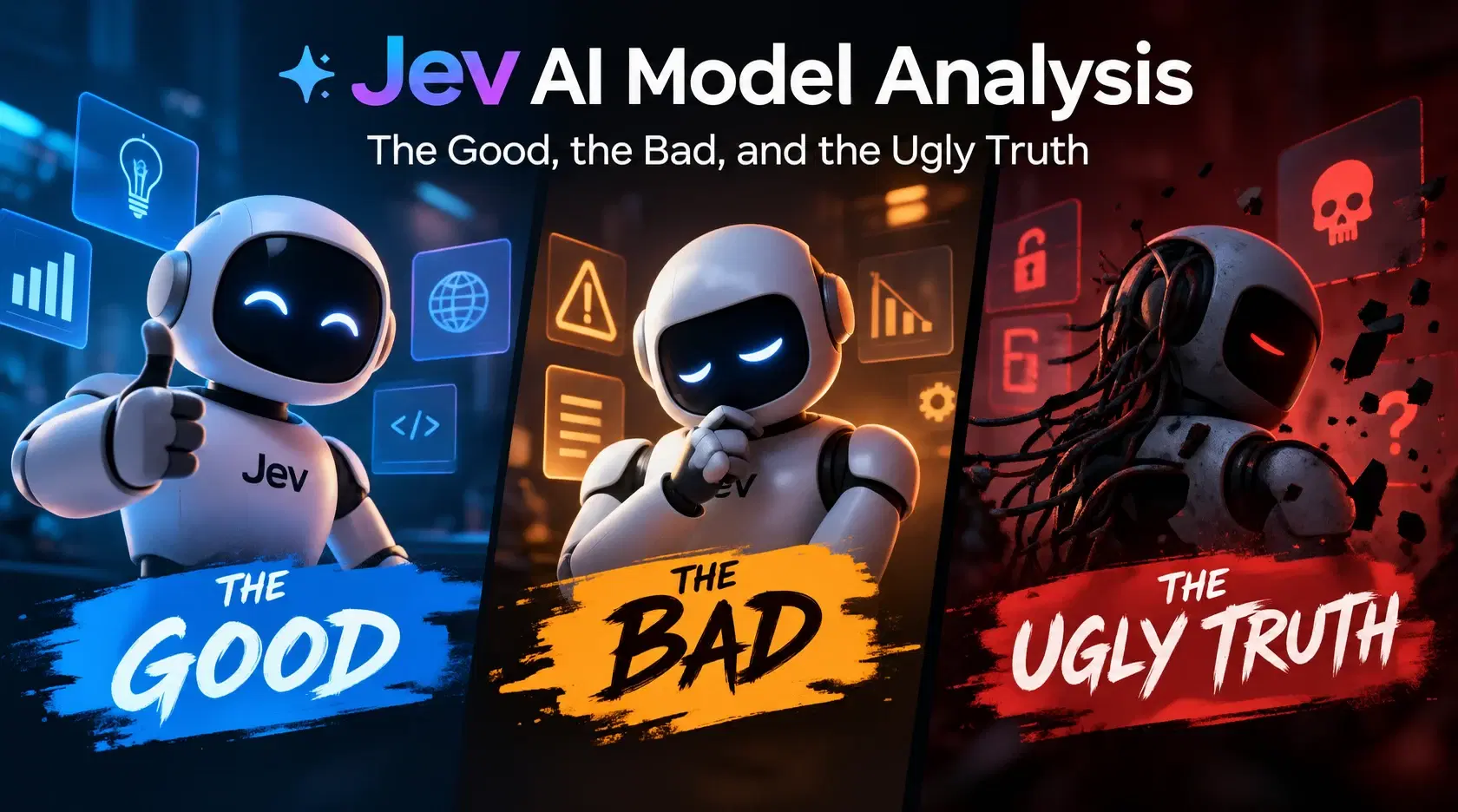
Businesses today grapple with a common problem: how to make automated decisions quickly and reliably. Large language models (LLMs) are powerful for generating text, but their free-form nature can be a liability when precise, structured choices are needed. This is where Jev AI, a non-autoregressive "System One" model from TypeSafe AI, offers a different approach. Launched in September 2026, Jev focuses on outputting structured decisions and probabilities, not conversational text.
The Good
Jev AI excels where speed and certainty are paramount. It is designed to be a fast, cost-effective decision layer for high-volume tasks. Jev processes requests with typical latencies between 70-500ms, making it significantly faster than frontier LLMs on comparable tasks, often 40-200 times quicker. This speed translates to lower operational costs, with Jev priced at $0.042 per million input tokens, and output tokens are free.
Its core strength lies in its structured outputs. Jev provides three decision primitives: 'choice' to select one from up to 255 options, 'score' to rate on an ordered scale, and 'noul' for a calibrated yes/no probability between 0 and 1. These outputs are "type-locked," meaning Jev cannot hallucinate a format or emit an invalid type. This ensures structural reliability, eliminating the need for complex parsing logic often required with LLM JSON modes.
Jev is trained with Reinforcement Learning for Calibrated Decisions (RLCD). This method optimizes for epistemically honest probabilities. When Jev states it is 80% sure, it should be correct about 80% of the time. This calibrated confidence allows engineers to build more trustworthy AI systems, making informed decisions about when to automate and when to involve a human.
Consider a customer support system handling many inbound messages. A customer writes: "Subject: Charged twice again!! Hi — this is the SECOND month in a row I've been billed twice for the Pro plan. I already emailed last month and nobody…" Jev can process this quickly. In a single API call, Jev can simultaneously classify the topic as 'billing', score the severity (e.g., 3 out of 3), and provide a high probability that the message needs immediate human escalation. This allows for rapid, automated routing and prioritization, ensuring critical issues are handled without delay.
The Bad
While Jev shines in specific areas, it has clear limitations. It is not a general-purpose language model. Jev struggles with tasks that require complex reasoning. This includes long-range logic, spatial geometry, counting, arithmetic, and date comparisons. For these types of problems, a different class of AI model would be more appropriate.
Another point of caution is the nature of its outputs. Jev guarantees zero format errors; it will always return a valid choice, score, or probability. However, this does not mean the content of the decision is always correct. Jev can still select a semantically incorrect business classification with high confidence. Engineers must carefully design the options and evaluate Jev's performance in context.
The Ugly Truth
The most significant challenge with Jev AI, for some, is its black-box nature. TypeSafe AI has not publicly disclosed Jev's internal architecture, parameter count, weights, base architecture, or the specifics of its training data. This lack of transparency can be a concern for applications requiring deep auditability or a clear understanding of how a decision was reached.
Jev does not output natural language reasoning processes, often called "Chain of Thought." It provides a probabilistic output, but not the steps it took to arrive at that probability. For highly regulated industries or critical applications where explaining why a decision was made is as important as the decision itself, this can be a significant drawback.
Furthermore, despite calibration being a core claim, TypeSafe AI has not published expected calibration error (ECE) metrics for Jev. While the RLCD training aims for honest probabilities, independent verification of these claims would strengthen trust.
A thoughtful reader might argue that Jev's black-box nature and limited reasoning make it unsuitable for complex or regulated applications. They might question the reliability of its 'calibrated probabilities' without publicly verifiable metrics. However, Jev is not designed to replace general-purpose LLMs for all tasks. Instead, it complements them. Jev provides a fast, cost-effective, and structurally reliable 'System One' decision layer for high-volume, specific tasks. Its strengths — speed, cost, structured output, and calibrated confidence for simple decisions — offer significant advantages over the slower, more expensive, and less predictable outputs of traditional LLMs in these targeted scenarios.
Jev AI is not a universal solution, but a specialized tool. It offers a powerful way to inject rapid, structured, and probabilistically calibrated decisions into AI workflows. Understanding its strengths and limitations is key to deploying it effectively, ensuring it serves as a valuable layer in complex AI systems rather than a misapplied general intelligence.
Thinking about this for your own business?
We have been building and running enterprise systems since 2011. Talk to a solutions lead about where agents pay off first.
Talk to a solutions lead