Client Profile
Industry: Manufacturing and Distribution Operational Footprint: Six warehouses across two countries Systems Environment: ERP, inventory databases, CRM, and BI dashboards
The Business Problem
Operational data was distributed across multiple systems, and leadership struggled to access timely, actionable insights.
Key challenges included:
- Fragmented data sources
- Overly complex dashboards with excessive filters
- Dependence on analysts for custom reports
- Slow response to inventory risks, including expiring products
Even simple operational questions often required hours of manual analysis.
The Challenge
Operational data was fragmented across multiple enterprise systems, making it difficult for leaders to access timely, actionable insights. Complex BI dashboards required heavy filtering and analyst support, causing delays even for simple operational questions. As a result, decision-making was slow, responses to inventory risks were delayed, and teams lacked an easy way to act directly on insights.
Why Traditional BI Was Not Enough
Business intelligence dashboards provided historical visibility but lacked:
- Natural language interaction
- Contextual understanding of operational intent
- The ability to take action on identified issues
Leaders could see what had happened but could not easily instruct systems on what to do next.
Solution Overview
A conversational AI operational layer was introduced, supported by:
- A secure protocol enabling AI to interact with enterprise systems
- A multi-agent reasoning architecture
- Controlled, auditable action execution through natural language commands
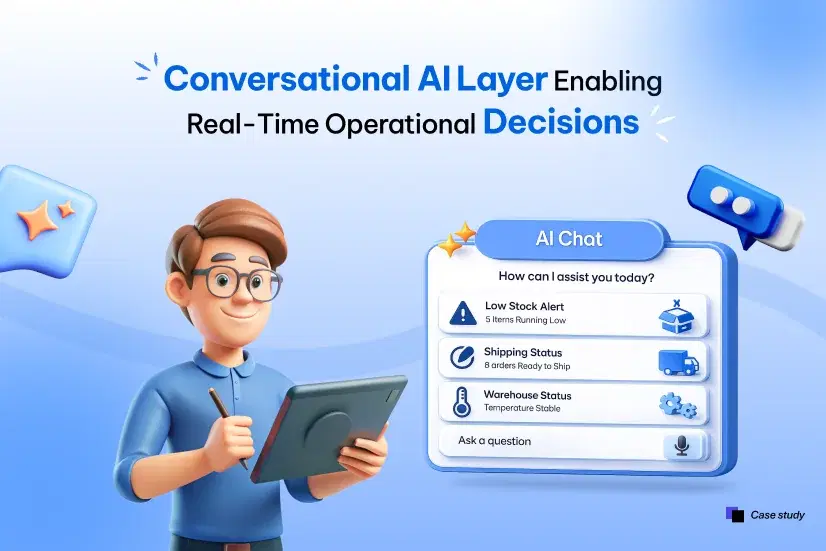
Users could ask operational questions and authorize system updates within the same interaction.
Implementation Journey
Phase 1 – Data Landscape Mapping (4 Weeks)
Data sources across ERP and warehouse systems were cataloged and standardized so the AI could understand structures and relationships.
Phase 2 – Secure AI Access Layer (5 Weeks)
A controlled integration layer was deployed to manage data access and define which system actions could be executed by AI, with role-based permissions.
Phase 3 – Multi-Agent Intelligence Configuration (4 Weeks)
Specialized AI agents were configured for intent interpretation, data retrieval, risk analysis, insight summarization, and action execution.
Phase 4 – Operational Rollout
The system was piloted with warehouse managers and gradually extended to regional and executive leadership teams.
Technical Operation (Summary)
When a user submitted a request, the system performed the following sequence:
- An intent-processing agent interpreted the operational question
- A data agent retrieved live information from enterprise systems
- An analysis agent applied business rules and thresholds
- An insight agent generated a decision-ready summary
- An action agent executed approved updates within permitted systems
All interactions and changes were logged for compliance and governance
Change Management
Managers were trained to review and confirm AI-suggested actions where required. Approval workflows were added for sensitive updates. Business analysts transitioned from manual reporting tasks to higher-value analytical and planning roles.
The Result
Metric
Before Implementation
After Implementation
Impact
Time to generate operational insights
2–4 hours
Under 10 minutes
80% reduction
Inventory loss from expiries
Baseline
Reduced
26% decrease
Analyst workload for ad-hoc reporting
High
Lower
38% reduction
Decision turnaround time
Several days
Same day
Major acceleration
Business Outcome
Operations evolved from reactive reporting to proactive decision-making. Leaders began interacting with enterprise data conversationally, enabling faster, more confident operational actions without navigating complex dashboards.
Have a system that needs to do this?
500+ systems shipped since 2011, and we still maintain most of them. Tell us what you are trying to move.