The Business Problem
Although lead generation was strong, the sales operation faced structural inefficiencies:
-
42% of outbound calls reached voicemail
-
Sales representatives spent nearly 30% of their time scheduling meetings
-
Follow-ups were inconsistent due to workload and prioritization gaps
-
Average lead response time was 19 hours
-
CRM updates were frequently delayed or incomplete
Leadership recognized that growth was constrained not by demand, but by human bandwidth and coordination overhead.
Limitations of Existing Systems
The organization already used CRM automation, email sequencing tools, and outbound dialers. However, these solutions:
-
Could not participate in live conversations
-
Could not execute business actions during calls
-
Still relied on manual scheduling and logging
Automation existed around the process, but not inside the conversation itself.
Solution Overview
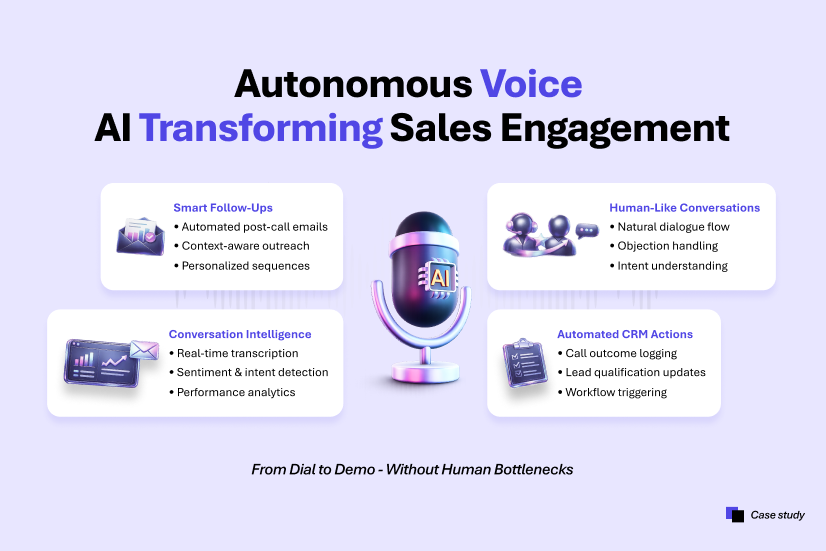
A real-time, agent-driven voice AI system was implemented as a frontline engagement layer for sales interactions.
The system was designed to:
-
Place outbound and callback calls
-
Conduct natural, human-like conversations
-
Understand intent and context in real time
-
Schedule meetings during the call
-
Detect and handle voicemail scenarios intelligently
-
Log outcomes and trigger follow-up workflows automatically
Implementation Journey
Phase 1 – Discovery and Conversation Analysis (3 Weeks)
Over 1,200 historical sales calls were analyzed to identify common conversation paths, objection patterns, qualification signals, and escalation triggers.
Phase 2 – Systems Integration (4 Weeks)
The AI system was integrated with:
Security controls and audit logging were configured at this stage.
Phase 3 – Controlled Pilot (6 Weeks)
A pilot group of four representatives used the system for overflow and after-hours calls. Performance was benchmarked against traditional outreach methods.
Phase 4 – Full Deployment
The AI began managing:
Human representatives focused only on high-intent conversations transferred by the system.
Technical Operation (Summary)
During live calls, the system:
-
Transcribed speech in real time
-
Interpreted user intent and conversation state
-
Determined the next best action using goal-driven reasoning
-
Invoked enterprise tools such as calendar booking, email delivery, and CRM updates
-
Adjusted responses based on tone and conversational flow
When voicemail was detected through audio pattern recognition, the system switched workflows to:
-
Deliver a contextual voicemail message
-
Send a personalized follow-up email
-
Schedule an automated retry attempt
All actions were recorded with full auditability.
Change Management
Sales representatives were trained to handle only qualified or escalated calls. Confidence thresholds controlled when the AI transferred calls to humans. Managers received weekly performance dashboards comparing AI-assisted and traditional workflows.
Initial skepticism shifted to strong adoption as representatives experienced reduced administrative burden and more productive selling time.